Our Services
Certified Post-Tension Repair
Post-tensioned concrete repairs are crucial for maintaining the integrity and safety of most concrete structures. In post-tensioned structures, steel tendons are utilized to reinforce the concrete, which results in enhanced durability and flexibility. Over time, post-tensioned steel may experience corrosion or other forms of degradation, which if left unchecked can compromise the structure's stability. Our certified post-tension concrete repair services involve assessing and addressing issues with the steel cables, using cutting edge techniques to prevent further damage, and ensuring the structure can withstand its intended loads. Our proactive solutions can significantly increase the lifespan of your parking garage or concrete building. We also do button head repairs as well!
Get a Quote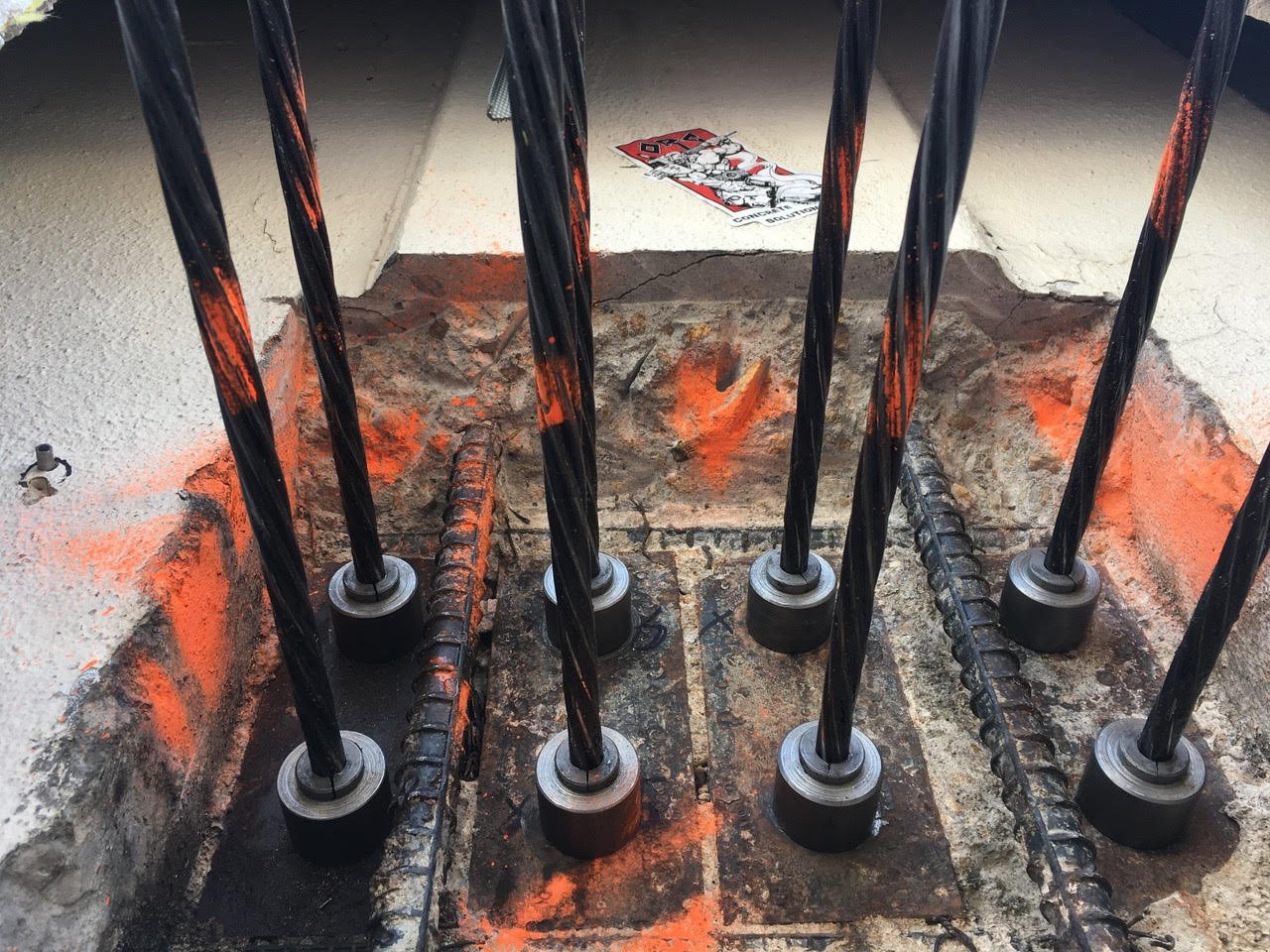
Certified through the Post-Tensioning Institute
The Institute grades its certification, and the grade is not decorative. Certain jobs require a Level 2 certified employee on site, which makes it a specific and checkable qualification rather than a general claim of competence. It means the people standing on your structure have been trained and tested on post-tension systems specifically, rather than the service appearing on a list of things a contractor is willing to take on. When you are deciding who should touch a post-tensioned slab, what certification the crew holds, and at what level, is a reasonable thing to ask for.
Antiquated button-head cable
Button-head post-tensioning was common in buildings put up from the 1950s through the 1970s. Instead of the greased and sheathed single strands used today, those systems use bundles of individual wires with heads formed on the ends, seated against an anchor plate and often run in paper wrapping or a duct. When water and chloride reach them, the wires corrode outward from the anchorage and fail one at a time, and the methods built for modern monostrand do not transfer. Repairing button-head cable means identifying what system is actually in the slab, locating the damaged wires, and restoring tension without disturbing what is still sound. ORC repairs and replaces button-head cable. If your building is from that era and nobody can tell you what is in the deck, that is worth a phone call before it becomes an emergency.
Barrier cable
Barrier cable is the horizontal cable run along the open edges and ramps of a parking structure to stop a vehicle going over the side. It is a life-safety system, it is tensioned, and it gets inspected. Cables lose tension, anchors and end fittings corrode, and a run that looks intact from the drive lane can have lost much of its capacity at the anchorage. ORC repairs, re-tensions and replaces barrier cable systems, either as part of a garage restoration or on its own. It is the same skill set as post-tension repair applied to a different assembly, which is why it usually comes from the same crew.
Unbonded monostrand
Monostrand is what most post-tensioned concrete built since the 1970s uses: a single greased strand inside a plastic sheath, stressed after the concrete is poured. It fails where the sheath is breached and water gets to the steel, most often at the anchorage or where a slab has been cored or cut without a scan. We locate the damaged tendon, de-tension it safely, replace or splice it, re-stress it, and rebuild the pocket.
Our certifications
ORC’s owner and members of our crew have been certified through the Post-Tensioning Institute for more than 25 years, which is longer than ORC has been in business. Members of our crew are certified at Level 1 and Level 2. Level 2 is the higher of the two, and certain jobs require a Level 2 certified employee on site. We are also members of the International Concrete Repair Institute.

Post-Tensioning Institute
Certified at Level 1 and Level 2
International Concrete Repair Institute
Member
Questions we get asked
How do I know whether my building even has post-tension cable in it?
If you have the as-built drawings you will know, but the majority of buildings no longer have their drawings. More often it gets handed down. A building engineer trains his replacement and tells him this deck is post-tensioned, so be careful how it is maintained and careful about drilling holes or doing demo. Where nobody knows and there are no drawings, an engineer can assess the building and determine how it was built. It is worth finding out, because a post-tension building needs particular care.
Can button-head cable be repaired, or does it always have to be replaced?
It can be repaired. It does not always have to come out. See antiquated button-head cable above for what that involves.
What happens if a tendon fails and nobody notices?
You get an eruption, which is the tendon coming through the concrete. That usually shows up at an end anchorage or somewhere the tendon runs close to the surface in its profile. What it means for the building is a separate question. A failed tendon takes away capacity the structure was designed to have, and it takes an engineer well versed in post-tension to run the calculations and work out whether that particular tendon was critical. We know engineers who understand post-tension structures and parking garages, and we will put you in touch with the right one.
Somebody needs to core or saw cut a post-tensioned slab. What should they do first?
Stop. That is genuinely the first thing to do. Everybody knows to call before you dig, and the same rule belongs here: call before you cut. We see it constantly. Somebody saw cuts a section of concrete out, de-tensions cables nobody knew were there, and what should have been a small job becomes an expensive one. The phone call costs nothing.
How long does a post-tension repair take, and does the garage have to close?
A single tendon repair can usually be made in two days to a week when everything runs smoothly. The garage rarely has to close. Most of the time we only need the repair area itself rather than the structure. We try to prioritize post-tension repairs and work them into the schedule, because they are the ones that should not wait. Where shoring is needed we bring it in through a subcontractor, as part of our scope rather than yours.
Related services
Parking Structure Restoration
Multi-level parking structures are what ORC is built around. Top deck restoration, post-tension repair, traffic coatings, joints and sealants, phased so the garage stays open while we work.
Learn MoreConcrete Structural Repairs
ORC specializes in lasting concrete structural repairs for multi-level parking structures, stadiums, office buildings, tilt ups, and residential properties.
Learn MoreCarbon Fiber Reinforcement
Cutting edge carbon fiber technology and materials are used to strengthen and repair concrete structures. Additionally carbon fiber technology can be used to replace or augment steel elements to mitigate unwanted movement and provide added strength or capacity.
Learn More